


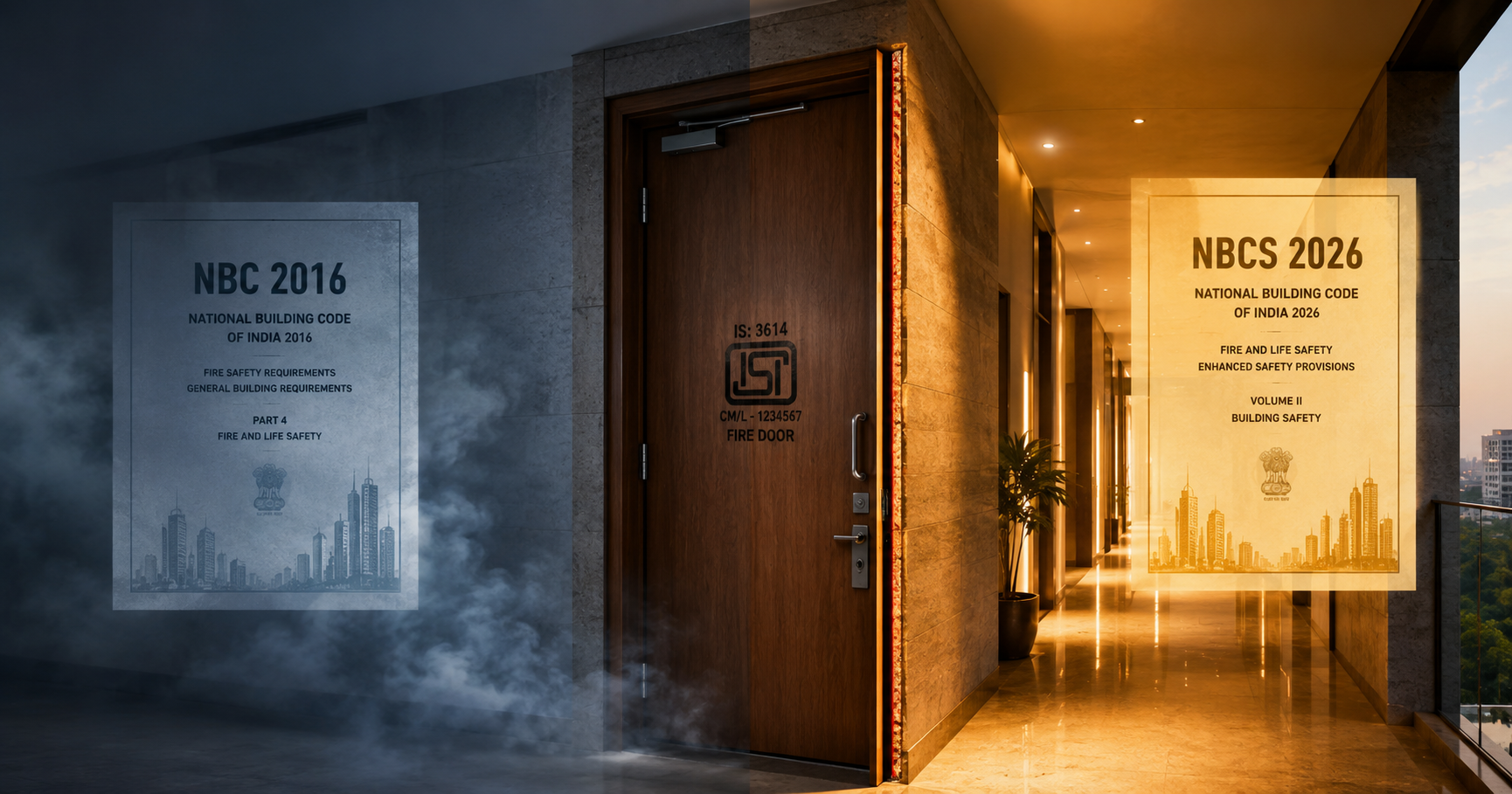
On 30 April 2026, India quietly changed the rules for every fire door specified, supplied, and signed off in the country. The Bureau of Indian Standards (BIS) withdrew the National Building Code of India 2016 (NBC 2016) and replaced it with SP 7 : 2026 — the National Building Construction Standards (NBCS) 2026. For most of the construction industry the headline was the rename. For anyone who specifies, approves, or manufactures fire doors, the real story is buried in Part F, Fire and Life Safety — the section that used to be called Part 4.
This guide walks through exactly what changed for fire doors, what stayed the same, and what project teams should be doing differently from now on. It is written for architects, fire consultants, PMCs, builders, and door specifiers who need a clear, accurate picture rather than alarmist headlines.
What Changed on 30 April 2026
The change is structural, not cosmetic. The document India has used as its master reference for fire and life safety since 2016 has been superseded. The fire-and-life-safety content now lives in Part F of NBCS 2026, carrying forward most of the technical substance of the old Part 4 but reframing how compliance is demonstrated and, importantly, removing the long-standing height-and-area limitation tables.
Three things matter immediately for door work:
- The reference your drawings cite has changed. Compliance language in BOQs, door schedules, and handover documents that names “NBC 2016 Part 4” is now pointing at a withdrawn document.
- The fire-door provisions have been tightened and clarified around the idea of a tested assembly, not a leaf.
- The route to proving compliance has shifted toward performance and test evidence, which rewards certified products and penalises uncertified, lowest-price substitutions.
NBC 2016 vs NBCS 2026: At a Glance
| Aspect | NBC 2016 (Part 4) | NBCS 2026 (Part F) |
|---|---|---|
| Document name | National Building Code 2016 | National Building Construction Standards 2026 (SP 7 : 2026) |
| Fire section | Part 4 — Fire & Life Safety | Part F — Fire & Life Safety |
| Compliance approach | Largely prescriptive (fixed build-ups, tabulated requirements) | Performance-oriented, with a new Annex M on performance-based design |
| Height/area limits | Limitation tables for heights and areas | Height restrictions eliminated |
| Legal status | Recommendatory; binding only where adopted by state byelaws | Explicitly voluntary and non-binding; guidance for states/local authorities |
| Fire door basis | Fire door / fire-check door | Fire door assembly (leaf, frame, seals, hardware tested together) |
| Door product standard | IS 3614 | IS 3614 : 2023 (latest revision, insulation reinstated) |
This single comparison is the thing most teams are searching for, and it is also the most misrepresented. The two rows worth pausing on are the legal status and the door-assembly definition.
From “Code” to “Standard”: Part 4 Becomes Part F
The rename from Code to Standards is not branding. NBC always sat in an unusual position — technically recommendatory, but treated as binding the moment a state or municipal body wrote it into its byelaws. NBCS 2026 makes that relationship explicit. The Part F text describes itself as guidance and referral material for state governments and local authorities, reflecting that fire services are a State subject under the Constitution.
In practice, this means the new standard does not “ban” anything by itself. What it does is set the technical benchmark that state fire departments, development authorities, and fire-NOC processes will increasingly adopt — and the direction of travel is unmistakable.
Prescriptive vs Performance-Oriented Compliance
Under the old prescriptive model, a designer reproduced the code’s fixed requirements on the drawings and that was compliance. NBCS 2026 leans toward outcomes: demonstrate that the assembly achieves the required fire resistance through test evidence. For doors, acceptable evidence routes include BIS product standards such as IS 3614, and internationally recognised methods like BS 476 Part 22 and EN 1634-1 where appropriate. A dedicated performance-based-design annex (Annex M) now formalises this approach.
The commercial effect is straightforward: manufacturers who can produce credible, assembly-level test data are advantaged, and anyone selling an uncertified door on price alone is exposed.
Height Restrictions Eliminated — and the Threshold Question
One of the most significant structural changes in NBCS 2026 is that the old building height-and-area limitation tables have been removed. NBC 2016 had effectively pegged much of the high-rise fire-safety package to fixed height bands. With those limits gone, the trigger for stringent fire-safety provisions now depends more heavily on occupancy, building type, and — crucially — the norms each state and local authority chooses to adopt. Expect city-by-city variation, and check the local development control regulations rather than assuming a single national threshold.
What Changed Specifically for Fire Doors
This is the part the broad “fire and insulation” articles skip. Part F treats the fire door as a complete assembly and attaches several specific requirements to doors used in exits:
- A fire door means a fire door assembly. Wherever the standard refers to a fire door or fire-check door, it must be read as the entire tested assembly — leaf, frame, seals, hinges, and hardware — not just the shutter.
- Intumescent (or equivalent) seals are required in exit doors. Exit fire doors must carry intumescent seals or equivalent heat-activated technology that expands on contact with heat or hot gases to maintain integrity.
- No hold-open. Doors must self-close. Fire doors in exits cannot be propped or held open; they must be kept closed and self-close via a door-closer spring mechanism.
- Panic hardware with re-entry provision. Where panic bars are fitted, a handle must be provided on the other side at the relevant levels to permit re-entry.
- Fire curtains cannot serve as fire exits. If used for compartmentation, an independent fire door meeting exit requirements must still be provided.
Ratings by location remain demanding. For protected shafts, firefighting-shaft doors are specified at the 120-minute level, and in single-staircase firefighting-shaft arrangements the standard sets a 2-hour fire door for the lobby and a 1-hour fire door for the stairwell.
IS 3614 : 2023 — The Governing Fire Door Standard
NBCS 2026 anchors fire-door performance to IS 3614 : 2023, the current revision of India’s fire door and doorset specification. The 2023 revision is significant because it reinstated and strengthened the insulation requirement and tightened the test procedure, requiring doors to be evaluated as complete assemblies. The “I” (insulation) criterion measures resistance to temperature rise on the unexposed face of the door — the side occupants stand on while evacuating — rather than integrity alone.
The practical consequence: an “integrity-only” door that holds back flame but lets the unexposed face heat dangerously is increasingly difficult to defend on a protected escape route.
UD, PI and ID: Fire Door Insulation Classifications Explained
IS 3614 : 2023 classifies fire doors by insulation performance, which is where the UD / PI / ID shorthand comes from:
- UD — Uninsulated: rated for integrity and stability but with no insulation performance criterion.
- PI — Partially Insulated: meets a defined level of insulation alongside integrity.
- ID — Insulated: the full insulation classification, controlling temperature rise on the unexposed face.
Because Part F emphasises the insulation criterion for doors on protected escape routes, the defensible specification on exits and in sleeping or non-ambulatory occupancies (hotels, hospitals, hostels) is a properly insulated assembly. Note that the material of the leaf — timber, steel, or glazed — is not itself the issue; the absence of a tested insulation rating is.
Is NBCS 2026 Binding or Voluntary?
This is the question with the most confusion in the market, and getting it right protects you on site.
NBCS 2026 is, by its own text, voluntary and non-binding at the national level. It is published as guidance for state governments and local authorities, consistent with fire services being a State subject. It does not, on its own, outlaw a product or override a state byelaw.
It becomes enforceable the moment a state fire services act, building byelaw, or development control regulation adopts it — or when a contract or fire-NOC condition references it. This is exactly how NBC 2016 operated. So the accurate statement is not “uninsulated doors are banned nationwide from 30 April 2026,” but rather: “NBCS 2026 sets the new benchmark, and as states and local authorities adopt it, uninsulated and integrity-only doors will fail specification and NOC scrutiny.” Treat any blanket “banned” claim with caution and verify against the byelaw that actually governs your project.
What This Means for Your Projects
For live and upcoming projects, the practical actions are:
- Update references. Door schedules, BOQs, specifications, and handover/purchase agreements that cite “NBC 2016 Part 4” should be revised to reference NBCS 2026 / SP 7 : 2026 and IS 3614 : 2023.
- Re-check exit-door specs. Confirm exit doors are specified as tested assemblies with the correct insulation classification, intumescent seals, self-closing hardware, and — where required — panic bars with re-entry handles.
- Collect assembly-level test evidence. Ask suppliers for certification covering the full doorset, not just the leaf.
- Confirm the local position. Because enforcement flows through state byelaws and the fire-NOC process, verify what your specific authority has adopted before finalising the schedule.
Retrofit Obligations for Existing Buildings
NBCS 2026 applies primarily to new construction and major refurbishment. There is no automatic national mandate to rip out and replace compliant existing doors. However, retrofit exposure typically arises during change of use, vertical additions, major renovation, or fire-NOC renewal — moments when the current standard tends to be applied. Obligations vary by state and by how the local fire authority interprets adoption, so existing-building owners should treat any major works or NOC renewal as a trigger to review door compliance.
NBCS 2026 Fire Door FAQs
Not as a matter of best practice on protected exits. NBCS 2026 and IS 3614 : 2023 emphasise the insulation criterion, so integrity-only (UD) doors are hard to defend on escape routes. Whether they are formally prohibited on your project depends on the byelaw your authority has adopted. The leaf material is not the problem — the missing insulation rating is.
Primarily to new build and major refurbishment. Retrofit obligations for existing buildings depend on the state and usually crystallise at change of use, major renovation, or fire-NOC renewal.
IS 3614 : 2023 is the current fire door and doorset specification referenced for product performance, with doors tested as complete assemblies.
The standard itself is voluntary and non-binding. It becomes enforceable when adopted by a state fire services act, building byelaw, development control regulation, or referenced in a contract or NOC condition.
The core rating expectations (for example, 120-minute doors for firefighting shafts) carry forward, but the emphasis on tested assemblies, insulation performance, intumescent seals, and self-closing hardware is stronger and clearer than under NBC 2016.