


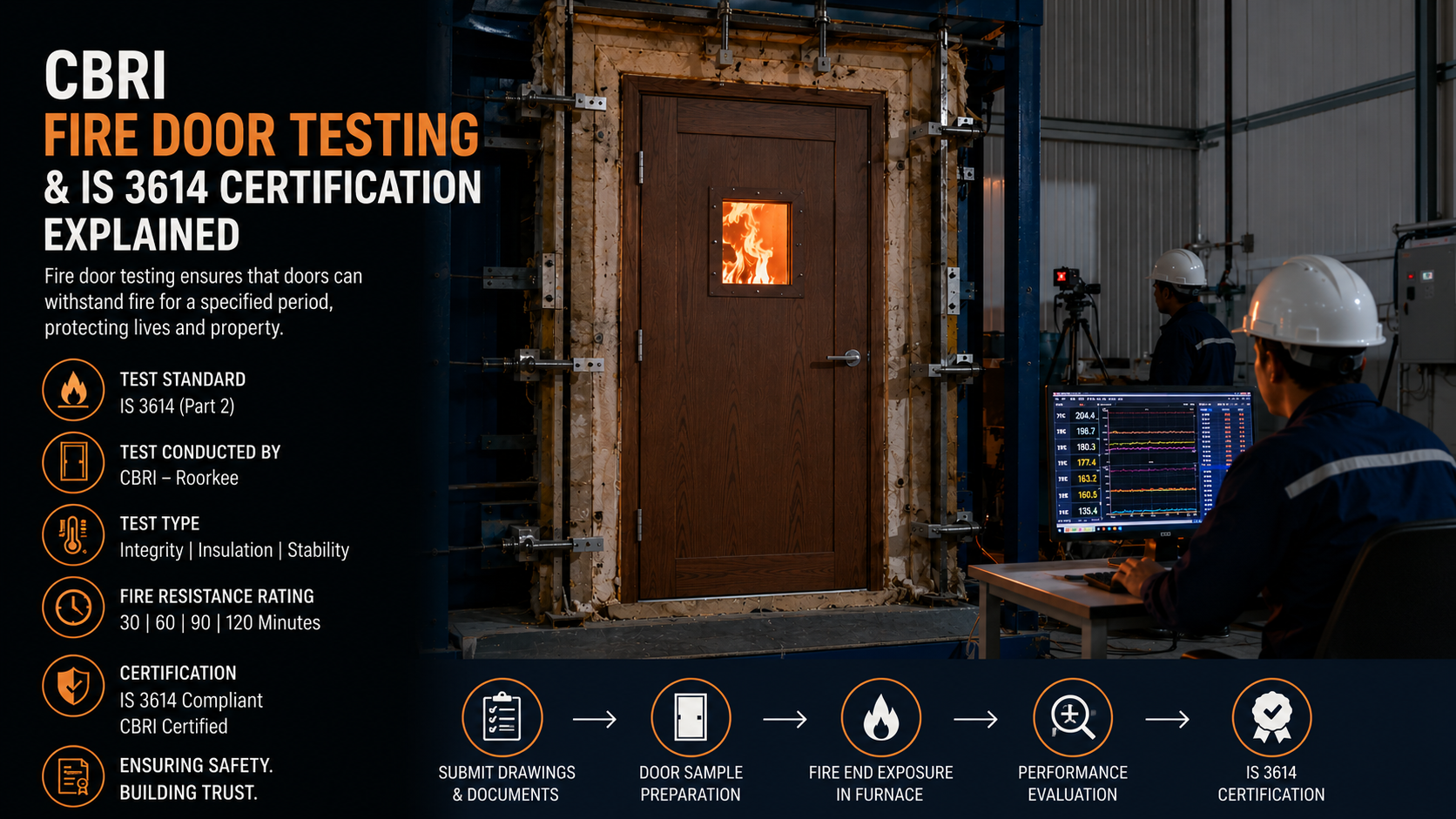
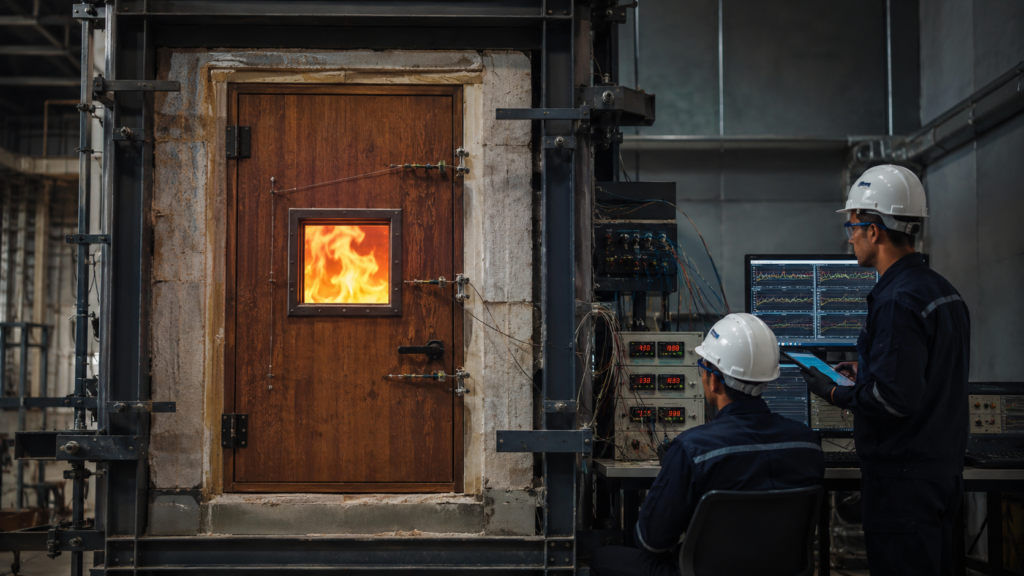
When a building catches fire, the difference between a tragedy and a near-miss is often measured in minutes — and a few of those minutes are bought by the doors. A certified fire door holds back flame, smoke, and searing heat long enough for people to escape and for firefighters to arrive. But how does anyone actually know a door will perform when it matters? The answer lies in a furnace in Roorkee and a rigorous process overseen by the CBRI.
At Tufwud, we believe specifiers, architects, and facility managers deserve to understand exactly what a fire-rating certificate represents. This guide walks through how a fire door is tested and certified in India — and, importantly, why a well-engineered wooden fire door can earn the very same rating as a steel one.
What Is CBRI and Why It Matters for Fire Doors
The Central Building Research Institute (CBRI) in Roorkee is a constituent laboratory of the Council of Scientific and Industrial Research (CSIR). It is the country’s premier authority for structural and fire-safety testing of building components, and its Fire Engineering Laboratory runs full-scale furnaces purpose-built to evaluate how doors, walls, dampers, and cables behave under real fire conditions.
When a manufacturer claims a door is “2-hour fire rated,” that claim only carries weight if it has been validated by a recognised laboratory like CBRI (or another NABL-accredited facility). A CBRI test report is, in practice, the gold-standard proof that a fire door does exactly what its label promises.
IS 3614: The Standard Behind Fire Door Certification
Fire door testing in India is governed by IS 3614, Fire Doors and Doorsets — Specification. The current document is IS 3614:2023 — the 2023 amendment reinstated the insulation requirement and tightened the test procedure. So any certificate or datasheet you rely on should reflect the current standard and its 2023 amendment, not a lapsed edition.
IS 3614 Part 1 vs Part 2
The standard is structured in two parts:
- Part 1 lays down the general requirements for materials, design, and construction.
- Part 2 defines the actual fire-resistance test method, plus the criteria a door must satisfy to pass.
Why the Complete Doorset Is Tested, Not Just the Leaf
IS 3614 evaluates the whole doorset — leaf, frame, hinges, locks, latches, door closer, intumescent seals, smoke seals, and any vision panels — tested together as one integrated assembly. A door is only as strong as its weakest component, so testing parts in isolation would be meaningless. The standard covers both steel doorsets and seasoned-hardwood (timber) doorsets, which is a point many buyers get wrong (more on that below).
The Three Things a Fire Door Must Prove
Under IS 3614, a fire door is judged against up to three performance criteria, expressed with letters borrowed from international convention.
Criterion | What it measures | What “failure” looks like |
Integrity (E) | Stops flames and hot gases crossing to the safe side | Sustained flaming, a cotton pad igniting, or a gap gauge passing through a crack |
Insulation (I) | Limits heat transfer to the unexposed face | Average temp rise above ~140 °C, or any single point above ~180 °C, over ambient |
Radiation (W) | Limits radiant heat passing through the assembly | Radiant heat high enough to ignite nearby materials on the safe side |
Integrity (E)
The door must not allow flames or hot gases to break through to the unexposed (safe) side. Cracks, gaps, or sustained flaming all count as failure.
Insulation (I)
The door must limit how much heat passes through. If the safe face gets hot enough to ignite materials leaning against it, or to burn someone touching it, the door has failed its insulation duty.
Radiation (W)
An additional classification on some doorsets, this measures radiant heat — because intense radiation can ignite nearby objects even when no flame physically passes through.
Fire Door Ratings Explained: FD30 to FD180
A door’s fire rating is simply how long it satisfies these criteria. IS 3614 defines five classifications, and each must be earned through its own separate furnace test — a door tested to 60 minutes cannot be sold as a 120-minute door.
Rating | Duration | Typical application |
FD30 | 30 minutes | Apartment entrance doors, residential corridors |
FD60 | 60 minutes | Offices, schools, hospital wards, high-rise lobbies |
FD90 | 90 minutes | Stairwells, plant rooms, service shafts |
FD120 | 120 minutes | Critical infrastructure, electrical/transformer rooms |
FD180 | 180 minutes | High-risk industrial separation, hazardous stores |
Inside the Furnace: The CBRI Test Process Step by Step
This is where theory meets fire.
Design Review and Sample Preparation
Before anything is lit, the doorset design is checked against IS 3614 — sheet thickness or timber core specification, seal types, hardware ratings, and tolerances such as the maximum permissible gap between leaf and frame. A full-size specimen is then built exactly as it will be supplied, and mounted into a test frame that replicates a real wall opening.
Fire Exposure and the Time–Temperature Curve
The mounted doorset becomes one face of a large vertical furnace. The furnace temperature is then driven along a standardised time–temperature curve (the ISO 834 / IS 3809 cellulosic fire curve). This curve is deliberately brutal:
Elapsed time | Approx. furnace temperature |
30 minutes | ~820 °C |
60 minutes | ~925 °C |
90 minutes | ~1,000 °C+ |
A controlled pressure regime is maintained so the test reflects how hot gases push against a door in a real building.
How a Pass or Fail Is Decided
Throughout the burn, technicians watch the unexposed face and thermocouples record its temperature continuously. The clock runs from ignition, and whichever criterion fails first sets the rated time:
- Integrity fails on sustained flaming, cotton-pad ignition, or a gap gauge passing through a developing crack.
- Insulation fails when the average temperature rise on the safe face exceeds ~140 °C, or any single point exceeds ~180 °C, above ambient.
If a 120-minute door holds full integrity and insulation right to the two-hour mark, it earns its FD120 classification.
Yes, Wooden Fire Doors Can Be CBRI-Certified
A common myth is that “only steel can be fire rated.” That is incorrect. IS 3614 explicitly covers seasoned-hardwood (timber) doorsets, and a properly engineered wooden fire door is subjected to the same furnace, the same time–temperature curve, and the same integrity and insulation criteria as a steel one.
What makes a timber fire door work is engineering, not luck: a dense fire-resistant core, intumescent seals that swell to choke off gaps as temperature rises, fire-rated hardware, and tight, tested tolerances. The payoff is a door that delivers certified protection while keeping the warmth and finish that architects and homeowners want — something a steel door simply cannot match. For projects that need fire safety and aesthetics, a certified timber doorset is often the smarter specification.
From Test Report to BIS ISI Mark Certification
Passing the furnace test produces a test report describing the assembly and the duration it withstood — the foundation for everything that follows.
For commercial sale, fire doors increasingly require the BIS ISI Mark under IS 3614, now brought under a Quality Control Order. Securing it involves not only the fire test but a factory inspection of the manufacturer’s quality systems, plus ongoing surveillance. Certificates carry a defined validity period (commonly around three years), and many project specs insist on certificates no older than five years — so re-testing and renewal are part of staying compliant. Budget time, too: the full testing and certification cycle typically runs several weeks to a few months.
Choosing a Certified Fire Door: What to Check
Use this quick checklist before you approve any fire door for a project:
- Ask for the actual test certificate — not a brochure claim.
- Confirm it references the current IS 3614 ( 2023 amendment).
- Match the rating to the application — a stairwell, server room, and chemical store may each need different durations.
- Check the certificate is current (and ideally no older than five years).
- Verify it covers the complete doorset, including the hardware actually being fitted.
- Install exactly as tested — correct gaps, anchoring, and rated hardware. A perfectly certified door fitted wrong no longer behaves like the one that passed in Roorkee.
Frequently Asked Questions
Is CBRI certification mandatory for fire doors in India? Fire doors must be tested at a recognised laboratory, and CBRI Roorkee is the benchmark facility. For commercial sale, doors increasingly also require the BIS ISI Mark under IS 3614. Always confirm the current requirements for your project.
Can wooden fire doors be CBRI-certified? Yes. IS 3614 covers seasoned-hardwood doorsets, and timber fire doors undergo the same furnace test and pass/fail criteria as steel doors when properly engineered.
How long is a CBRI fire door certificate valid? Certificates carry a defined validity period — commonly around three years — and many project specifications ask for test certificates no older than five years, so periodic re-testing is expected.
The Tufwud Commitment to Certified Fire Safety
Every fire door is, at heart, a life-safety product. At Tufwud, certification is not a box-ticking exercise but the whole point — engineering doorsets that pass the furnace honestly, and giving clients the documentation to prove it. As specialists in timber doors, we are especially proud that beautifully finished wooden doors can meet the same demanding ratings as steel.
Looking for IS 3614-compliant fire doors with verified test documentation? Talk to the Tufwud team about the right rating for your project.