


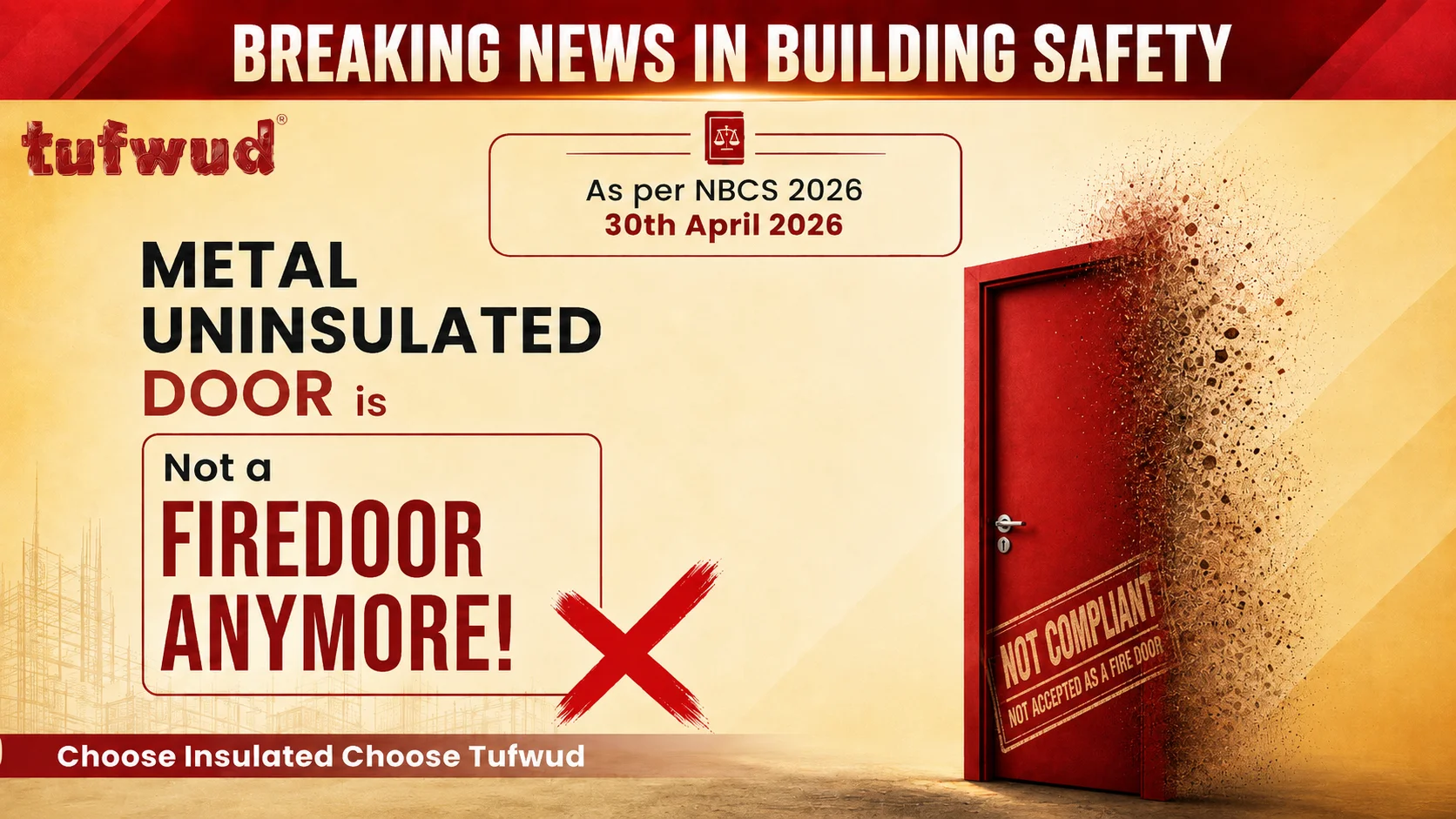
Why an Uninsulated Metal Fire Door No Longer Counts as a Fire Door in India ?
If you specified a metal fire door for an exit last week, I have some uncomfortable news for you. It’s probably not compliant anymore.Stay with me — this is going to take five minutes, and it might save your next project from a costly rework.
What actually happened on 30 April 2026
On 30 April 2026, the Bureau of Indian Standards quietly published a gazette notification that did two things on the same day. It withdrew the National Building Code 2016 — the document that has governed fire safety specifications across India for nearly a decade. And it released its replacement: the National Building Construction Standards 2026, or NBCS 2026.
Most architects and fire engineers I’ve spoken to since haven’t read it yet. Which is exactly why we need to talk.
So why is your metal fire door no longer a fire door?
Here’s the short version: under NBCS 2026, an uninsulated fire door — even one that meets every other test parameter — is no longer considered compliant in any Indian exit.
If your spec reads “120-minute metal fire door, uninsulated,” you have a problem.
So why is your metal fire door no longer a fire door?
NBCS 2026, Part F, Clause 2.22 redefines what a fire door actually is. And inside that definition, in Note 2, you’ll find this line:
“The minimum insulation criteria should be 30 min.”
Eleven words. No exceptions. No grandfather clauses. No “for buildings above 24 metres” qualifier. Every fire door installed in an Indian exit, from today onwards, must hold heat back for at least 30 minutes on the unexposed side.
What "insulation" actually means here
A fire door is tested on three parameters: stability (it stays in its frame), integrity (it doesn’t crack and let flames through), and insulation (the side facing away from the fire doesn’t get dangerously hot).
Older Indian codes were lax on the third one. A plain steel door could pass stability and integrity for two hours while the unexposed surface reached 400°C — hot enough to ignite anything touching it on the supposed “safe” side. NBCS 2026 closed that loophole.
UD vs PI vs ID — the suffix that decides everything
Here’s where IS 3614:2023 comes in. The 2023 amendment to IS 3614 introduced three suffixes to classify fire doors by insulation level — and NBCS 2026 has now made those suffixes the deciding factor.
| Suffix | Full Name | Insulation Rating | Status under NBCS 2026 |
|---|---|---|---|
| UD | Uninsulated Door | None | ❌ Non-compliant in any Indian exit |
| PI | Partially Insulated | Minimum 30 minutes | ✅ Compliant — minimum spec for normal exits |
| ID | Insulated Door (fully) | Full rating (60 / 120 min) | ✅ Recommended — required for hospitals, hotels, high-rise lobbies |
So when you write “FD120” in a BOQ today, the suffix that follows it isn’t optional anymore. FD120 UD is dead. FD120 PI is the new floor. FD120 ID is the safe ceiling for sleeping accommodations.
The 6 binding rules of NBCS 2026 Part F, Clause 2.22
Beyond the insulation rule, Clause 2.22 introduces six binding requirements every fire door must now meet:
- The complete assembly rule — a "fire door" means the leaf, frame, hardware, and seals together. Mixing components from different manufacturers voids the rating.
- Intumescent seals are mandatory — the strip in the door edge that swells under heat to seal the gap. No more skipping this to save cost.
- No hold-open hardware — fire doors must self-close via spring closer. Magnetic hold-opens are allowed only if they release on fire alarm.
- Trim lock on the unexposed side of panic-bar doors — at designated floors, firefighters must be able to re-enter from the stairwell. This single rule will affect almost every architect's drawings.
- Fire curtains cannot be exits — they're for compartmentation only. An independent fire door must be provided within the prescribed travel distance.
- Minimum 30 minutes of insulation — the rule that matters most.
Where 120-minute fire doors are now mandatory
- Clause 2.22 sets the baseline for every fire door. But four other clauses in NBCS 2026 tell you exactly where a 120-minute fire door — not a 60-minute one — is the only acceptable specification.
- Firefighting shafts (Clause 2.24) must be enclosed in a 120-minute protected envelope with 120-minute fire doors at every floor.
- Horizontal exits (Clause 2.40) require a fire door of 120-minute rating set in a fire-resistant wall, with a matching 120-minute fire barrier separating it from the refuge area or adjoining compartment.
- Internal staircases in high-rise and special buildings (Clauses 4.4.2.4.3.1 and 4.4.2.4.3.2) must have a minimum of two staircases, constructed in non-combustible material with a 120-minute fire-resistant rating. Access to every fire exit staircase must be through a fire door of minimum 120-minute rating. Staircase widths are now occupancy-specific — 1.50 m for hotels, 2.00 m for hospitals.
What this means if you are an architect, fire engineer, or builder
Your drawings need to be updated. Today.If you specify a UD door anywhere in an exit pathway and a fire incident happens, you carry personal liability. The code is now explicit. There is no ambiguity to hide behind.
For hospitals and hotels — where occupants may be sleeping or non-ambulatory — the recommendation goes one step further: FD120 ID (fully insulated) is the safe specification. The added cost is small. The protection is the difference between an evacuation and a tragedy.
Where Tufwud fits in
In other words, we were day-zero ready for NBCS 2026 because the standard finally caught up to what we’d already been building.
Contact
Us
Have a question or feedback?
Fill out the form below, and we’ll respond promptly!
+91 84200 50758