


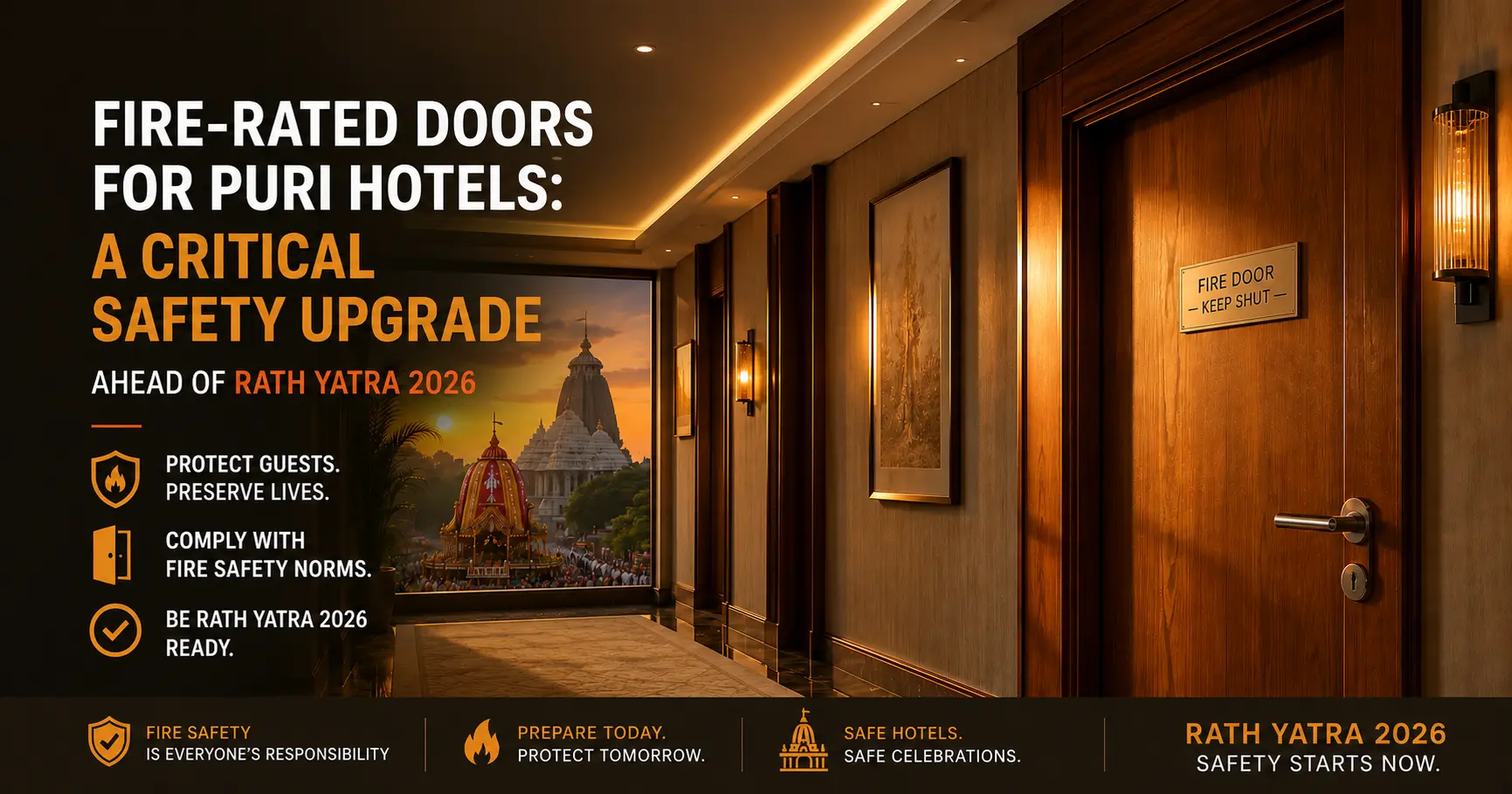
With Rath Yatra 2026 falling on Thursday, 16 July (Bahuda Yatra on 24 July, Suna Besha on 25 July), Puri is preparing to host several lakh devotees over a single fortnight. For the town’s hotels, that surge means full occupancy — and full responsibility for guest safety. This year, fire-rated doors in restaurants and staircases have moved from a recommendation to a non-negotiable compliance requirement.
Why fire safety is in the spotlight
Following a high-profile market fire in Bhubaneswar earlier in 2026, the Odisha government has tightened its fire-preparedness stance. Ahead of Rath Yatra, the Chief Secretary ordered special fire-safety inspection drives in Puri focused on hotels and crowded areas — part of a “Zero Casualty” festival blueprint backed by roughly 1,500 fire-service personnel. Properties that cannot show compliant fire doors on escape routes and high-risk areas face notices, penalties, or even suspension of operating clearance — at the worst possible time for revenue.
Where the risk concentrates
Hotels combine three hazards under one roof: a kitchen with open flame and cooking oil, dense overnight occupancy by guests unfamiliar with the layout, and staircases that act like chimneys for smoke. Kitchens are among the most common ignition points in hospitality buildings, and a fire-rated door contains a kitchen fire long enough to evacuate. Staircases are the lifeline — but an unprotected stairwell fills with toxic smoke within minutes, turning the one escape route into a death trap. This is why the directive emphasises restaurants and staircases for Puri’s two-star-plus hotels.
What “fire-rated” actually means
A fire-rated door is not simply a heavy door — it is a tested assembly (leaf, frame, hinges, closer and seals certified together) that holds back fire and smoke against three criteria: Integrity (no flames or hot gases reaching the safe side), Insulation (limited heat rise so radiant heat alone cannot injure people), and Stability (the door staying in place). Ratings run 30, 60, 90 and 120 minutes — a 60-minute door buys an hour of protected escape time.
The rulebook just changed — NBCS 2026
On 30 April 2026, the Bureau of Indian Standards withdrew the old National Building Code 2016 and replaced it with the National Building Construction Standards 2026 (NBCS 2026 / SP 7:2026). Fire and life safety now sits under Part F, in a performance-oriented framework.
One change is decisive for hotels. Under Part F, Clause 2.22, every fire door in an exit must now provide a minimum 30 minutes of insulation — no exceptions, regardless of building height or occupancy. In plain terms, an uninsulated metal door that merely resists flame is no longer compliant; it must also keep the safe-side surface cool enough that fleeing guests are not burned by radiant heat.
Compliance rests on two pillars. NBCS 2026, Part F dictates where fire doors are required and the rating each needs; it raised the central high-rise threshold from 15 m to 24 m, though Odisha’s fire authority may set stricter limits. IS 3614:2023 is the only fire-door product standard cross-referenced in NBCS 2026, now the governing test standard for every fire door in India. Compliant doors carry the ISI mark with a verifiable BIS licence, tested at CBRI Roorkee or NABL labs. Always ask for the IS 3614:2023 certificate, not a brochure claim.
Choosing the right door: three options
Matching the door to the location keeps you compliant without overspending.
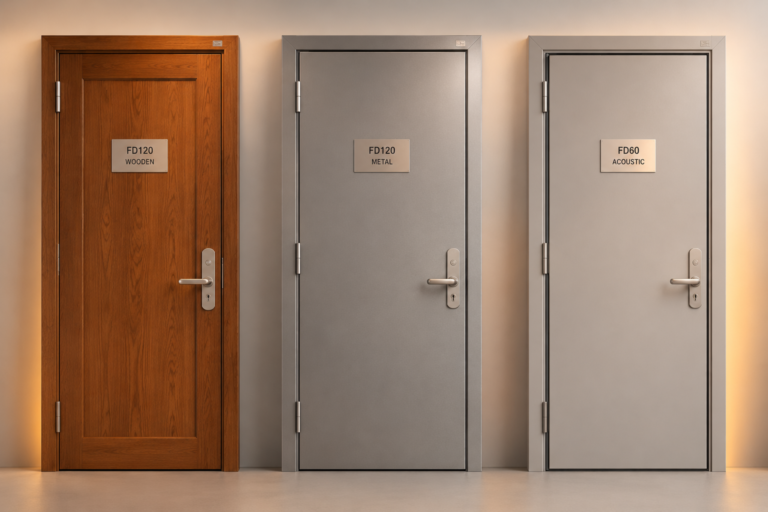
- Fully Insulated Wooden Fire Door — engineered to NBCS 2026. A timber skin over a high-density fire core that meets both integrity and the mandatory 30-minute insulation minimum. The warm finish suits guest corridors, lobbies and restaurant entrances far better than bare steel. Available in 30–120 minutes.
- Metal Fire Door. Pressed steel over a mineral-wool core, for back-of-house and high-hazard openings. Specify the insulated version to stay compliant. Best for kitchens, generator and electrical rooms, service corridors and firefighting shafts, at 90–120 minutes.
- Soundproof Fire Door. A fire rating plus an acoustic rating (around STC 45), blocking flame, smoke and noise together. Best for restaurant/banquet-to-corridor doors and openings between public areas and guest rooms.
All three ship as complete single-manufacturer certified assemblies, tested together to IS 3614:2023.
What to specify in your hotel — location by location
Two numbers describe a fire door, and they are easy to confuse. They measure different things, and both matter.
- Insulation minimum (the “30-minute floor”). Every fire door in an exit must provide at least 30 minutes of insulation — everywhere, regardless of height or occupancy. Uninsulated (UD) doors are no longer compliant. Only two classes are permitted: PI (Partially Insulated), meeting the 30-minute floor, and ID (Insulated), where insulation holds for the door’s full rating.
- Fire-resistance rating (30 / 60 / 90 / 120 minutes). How long the door holds back fire for stability and integrity — this changes by location. An “FD 120” door resists fire for 120 minutes; pair it with PI and insulation lasts 30 minutes, or with ID and it lasts the full 120 (FD 120 ID).
So “is it 30 or 120 for a hotel?” The insulation floor is always 30 minutes, but the rating is location-dependent — a staircase door must be FD 120, a guest-room door FD 60. Here is the grid:
Hotel location | Minimum spec | Recommended |
Internal staircases & exit corridors | FD 120 PI | FD 120 ID |
Hotel guest room main doors | FD 60 PI | FD 60 ID |
Sleeping accommodation (guest floors) | FD 120 ID | FD 120 ID |
Kitchens & high-hazard rooms (generator, electrical) | FD 90–120 (insulated metal) | FD 120 ID |
Restaurant / banquet to corridor | FD 60 (with acoustic seal) | FD 60 ID + STC ~45 |
One point is hotel-specific. Sleeping and non-ambulatory occupants cannot evacuate quickly, so for guest floors and the staircases serving them, the ID (fully insulated) class is the defensible choice — not merely the PI minimum. Where budget forces a choice, spend on ID for staircases and sleeping floors first.
A compliant door is more than the leaf
Most doors fail inspection because the assembly was compromised on site. A compliant fire door needs a self-closing device (or electromagnetic hold-open linked to the alarm), intumescent and smoke seals, correct gap tolerances (≤3 mm sides/top, ≤8 mm bottom), tested matched hardware, and clear “Fire Door — Keep Shut” signage. A door propped open with a wedge is not a fire door at all.
Why now matters
Rath Yatra is on 16 July, and surveying, ordering certified doorsets to size, installing, commissioning, then re-applying for the Fire NOC takes weeks, not days. Hotels that start now can audit their restaurant and staircase doors against NBCS 2026 and IS 3614:2023, order certified doorsets in the right ratings, install and commission with time to spare, and re-apply for the Fire NOC so the certificate is valid before inspectors arrive. Leaving this to July risks rushed installation, supply shortages as every hotel scrambles at once, and failing inspection in peak season.
The bottom line
Fire-rated doors are the difference between a contained incident and a tragedy in a building full of sleeping guests. With Odisha actively inspecting Puri’s hotels and the festival weeks away, certified fire doors in your restaurant and staircases are both a legal and a moral obligation.
Tufwud manufactures fully insulated wooden, metal and soundproof fire-rated doorsets tested to IS 3614:2023 and BS 476 — built to the insulation standard NBCS 2026 now makes mandatory — and supplied as complete certified assemblies. For a pre-Rath-Yatra fire-door audit or a fast-tracked supply-and-install plan, reach out today. There is still time to get it right before 16 July.
Jai Jagannath. Stay safe, stay compliant.