


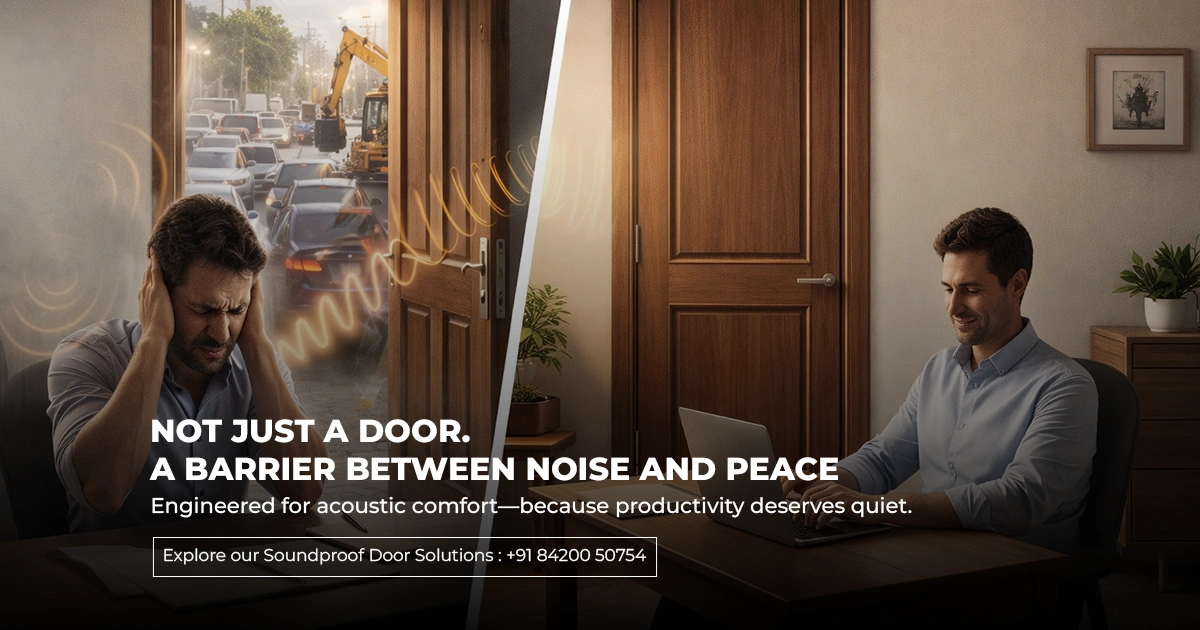
A soundproof door is not a purchase decision; it is a specification decision.
Their overall cost is driven by measured sound reduction (dB / STC), fire compliance, core construction, frame–seal systems, and installation accuracy. If two acoustic doors look similar but perform differently on site, the difference almost always lies in tested performance—not appearance.
Why Acoustic Door Costs Vary in India
soundproof door price in India varies because these doors are engineered systems, not decorative products. The final value depends on how much sound the door is proven to block, whether it must also meet fire-rating requirements, and how precisely the frame, seals, and shutter are integrated. Doors marketed as “soundproof” without test data may appear similar but often fail to deliver consistent on-site performance.
Acoustic door cost → depends on → tested performance and compliance scope
Key Factors That Influence Acoustic Door Cost
Sound Insulation Performance (dB / STC Rating)
Entry-level soundproof doors: Suitable for speech privacy and meeting rooms
Mid-performance acoustic doors: Designed for conference rooms and hospitality
High-performance acoustic doors (≈42 dB): Required for studios, cinemas, hospitals
Doors tested as per ISO 10140-2 / ASTM E90 cost more because they require:
Higher mass
Multi-layer damping
Airtight perimeter sealing
Door Core & Infill Construction
Basic constructions typically use:
Low-density fillers
Minimal damping layers
Limited vibration control
High-performance soundproofing doors use:
Ceramic fibre or mineral wool
Vermiculite-based mass layers
Rubber membrane interlayers
Calcium silicate boards
Core infill design → determines → sound transmission loss and long-term stability
Need Help Finalising the Right soundproof door Specification?
Contact
Us
Have a question or feedback?
Fill out the form below, and we’ll respond promptly!
+91 84200 50758
Fire Rating & Compliance Requirements
Non-fire soundproof doors (acoustic doors) ≠ soundproof (acoustic)fire doors
FD 60 and FD 120 doors are tested as complete assemblies under IS 3614
Fire-rated acoustic doors integrate fire resistance + sound control
Compliance Checklist
IS 3614 (Part 1 & 2) fire testing
ISO 10140-2 / ASTM E90 acoustic testing
Intumescent & acoustic seals tested together
Frame, Seals & Installation Accuracy
Engineered hardwood / DVL frames outperform softwood
Double rebate frames improve airtightness
Continuous acoustic seals are non-negotiable
Installation gaps >3 mm can reduce performance by 8–10 dB
Acoustic Door Selection by Application
| Application | Recommended Performance Focus | Fire Requirement |
|---|---|---|
| Recording Studios | Maximum dB reduction, airtight seals | Optional / FD 120 |
| Conference Rooms | Speech privacy, consistent closure | FD 60 |
| Cinema Halls | High dB + vibration control | FD 120 mandatory |
| Hospitals | Noise + life safety | FD 120 mandatory |
| Hotels | Guest comfort + compliance | FD 60 / FD 120 |
Acoustic Door vs Acoustic Fire Door
| Parameter | Acoustic Door | Acoustic Fire Door |
|---|---|---|
| Primary Purpose | Sound control | Sound + life safety |
| Testing Scope | Acoustic only | Acoustic + fire |
| Construction | Multi-layer damping | Multi-layer + fire-resistant |
| Where Used | Studios, offices | Cinemas, hospitals, hotels |
How Architects Can Specify the Right soundproof door price
Define the Required dB Reduction
Start by identifying how much sound needs to be controlled, not which door to use. Different spaces demand different acoustic outcomes. The required dB reduction should be aligned with the function of the space, background noise levels, and user sensitivity, not assumptions
Check Fire Code Obligations
Before finalising any acoustic specification, confirm whether the door opening falls under mandatory fire-rating requirements. In commercial buildings, hospitals, hotels, and cinemas, local fire authorities and NBC guidelines often require FD 60 or FD 120 doors.
Demand Test Reports
Marketing literature cannot replace laboratory evidence. Always ask for acoustic test reports conducted as per ISO 10140-2 or ASTM E90, and fire test reports as per IS 3614 where applicable.
Align Door Performance with Wall Performance
The door’s sound reduction should be balanced with the surrounding wall, glazing, and ceiling construction to achieve meaningful results. This alignment ensures budget efficiency and predictable acoustic outcomes.
Why Choose Tufwud Soundproof Fire Doors
| Specification Parameter | Typical Market Offering | Tufwud Acoustic Fire Doors |
|---|---|---|
| Acoustic Performance Validation | Often claimed without lab data | Tested up to 42 dB sound transmission loss at ARAI |
| Fire + Acoustic Integration | Fire and acoustic performance treated separately | FD 120 acoustic fire doors engineered and tested as a single system |
| Frame Construction | Softwood or generic hardwood frames | Engineered, treated DVL frames for long-term dimensional stability |
| Seal System | Basic or discontinuous sealing | Hafele acoustic seals integrated into the frame for airtight closure |
| Standards & Compliance | Limited or unclear testing references | Tested to ISO 10140-2 / ASTM E90 (acoustic) and IS 3614 (fire) |
Tufwud Soundproof doors: Designed dor quiet comfortable living
FAQ
What makes an soundproof door different from a regular door?
An acoustic door is engineered to control sound transmission, not just close an opening. Unlike regular doors, it uses high-density core infills, airtight frame–seal systems, and tested construction to reduce noise leakage. Performance is defined by measured sound transmission loss (dB / STC) rather than material thickness or appearance alone.
How much sound reduction do I actually need?
The required dB reduction depends on the function of the space. Conference rooms typically require moderate speech privacy, while cinemas, studios, and hospitals demand higher sound isolation. Over-specifying adds complexity, while under-specifying leads to acoustic failure—so performance should always be defined by use case, not assumptions.
When is a fire-rated soundproof door required?
Fire-rated acoustic doors are mandatory in many commercial, healthcare, hospitality, and cinema projects, depending on fire compartmentation and local code requirements. These doors must meet both fire resistance and acoustic performance, tested together as a single assembly—not added later.
Why is the frame and seal system so critical in soundproof doors?
Even a high-performance acoustic shutter will fail if sound escapes through gaps. Engineered fire resistant frames, double rebates, and continuous acoustic seals ensure airtight closure. In many site failures, the issue lies not with the door leaf—but with the frame–seal interface or installation tolerance.